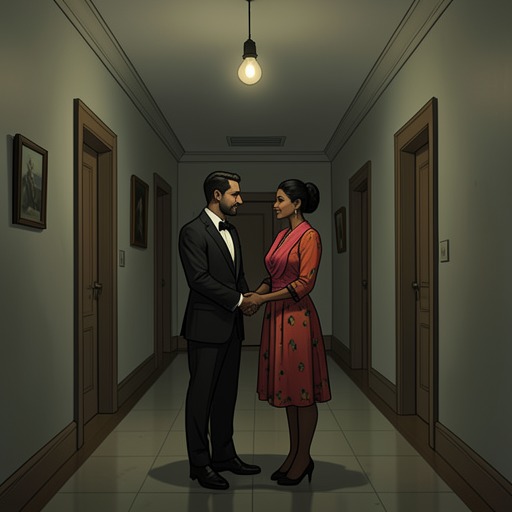
Fox and Crown
The RadleysThe Fox and Crown is where Peter Radley turns a date with Lorna Felt into a vigil from the safety of his car. Outside the pub, ordinary pleasures—music, country walks, and couples making an evening of their lives—become a measure of what Peter feels he cannot have. The location concentrates his conflict between temptation, his marriage to Helen Radley, and a sense of duty to his son, Rowan Radley: he watches, reads, and finally leaves without going in.
Setting and social scene
Peter sits sealed inside his car as couples head into the pub. He watches them fill their time with cultural events, country walks, and jazz evenings, and imagines the ease of being a normal human who could stop wanting more. The contrast is pointed: the people entering the Fox and Crown appear absorbed in ordinary companionship, while Peter remains physically close to the evening and emotionally set apart from it.
Lorna is waiting inside, alone at a table, listening to balding part-time musicians and wondering whether Peter has stood her up. Trumpets carry out to him through the air, but rather than drawing him in, the music makes him feel strange. The pub thus holds two versions of the date at once: Lorna’s expectation inside and Peter’s stalled, private deliberation outside. His protected car is not a way into social life so much as a barrier that lets him postpone choosing whether to join it.
A watchful and exposed position
Peter’s attempt to remain unnoticed is complicated when another car pulls into the car park. He thinks he recognizes the woman as Jessica Gutheridge, a card designer whom Helen knows and who attends Helen’s book group. Helen had pointed her out at a Christmas market in York some time earlier; Peter has never met her. He judges it unlikely that Jessica would recognize him, but the possibility is enough to make the evening feel riskier. As Jessica and the other person leave their car and walk toward the pub, Peter sinks lower in his seat. They do not turn toward him.
Distance matters as much as concealment. Peter thinks Farley is too close and that he and Lorna would have been better off choosing somewhere farther away. The pub’s location makes the prospect of being seen by someone connected to Helen part of the date’s pressure. Even while Jessica passes without noticing him, Peter cannot treat the car park as a private refuge: its proximity to the people and routines of Helen’s life keeps the possibility of exposure in view.
The past intrudes on the date
Peter’s attention repeatedly returns to Helen. He remembers how besotted they once were, and how the rainy streets of Clapham, before its gentrification, had seemed romantic to them without any need for Venice or Paris. That remembered closeness sharpens the present absence: Peter knows Helen has lost something, but does not know how to bring it back. His concern is not simply whether to accept a new pleasure; it is whether the intimacy he wants elsewhere can answer the distance he feels in his marriage.
The exhilaration he had felt after drinking Lorna’s blood has vanished by the time he sits outside the pub. What remains is temptation without its earlier glamour. Peter recognizes that he loves Helen and always has, yet thinks that if he felt she loved him in return, he would not be there, blood or no blood. The car park becomes the setting in which desire loses its intoxicating shine and gives way to the unresolved question of what his marriage still means to him.
Reading, recognition, and departure
While he waits, Peter consults The Abstainer’s Handbook, turning to a chapter on sex without blood. Its advice includes breathing techniques, attention to the skin, and methods for suppressing blood-related responses; if those fail, it recommends withdrawing from sex and repeating the abstainer’s mantra. The practical instructions sit beside Peter’s immediate predicament. He is not merely considering Lorna as a date: his recent drinking and his awareness of temptation make restraint an active problem, one for which the handbook offers procedures rather than reassurance.
Peter looks back toward the road as cars arrive and a bus passes. Through its glass, he thinks he sees Rowan’s forlorn face. He wonders whether Rowan saw him and whether his son knows something; the possibility frightens him. In that moment, the feeling inside him changes from fluid pleasure to solid duty. Peter starts the engine and heads home, leaving Lorna waiting at the Fox and Crown.
The pub’s importance lies in this reversal rather than in any meeting there. Peter begins the scene watching other people enter and imagining the ordinary life from which he feels excluded; he ends it acting on a fragile perception of his son and returning to his family. The Fox and Crown marks the point where renewed appetite, marital longing, and parental responsibility briefly converge—and where duty, not the promise of the date, determines what Peter does next.